How can we build, live, and work while conserving resources and reducing emissions? The 2022 issue of INDUS’s sustainability magazine, SUSTAIN, focuses on sustainable construction and highlights the opportunities offered by innovative technologies, smart planning, and new approaches to the circular econony.
It’s not just about energy-efficient buildings. The magazine examines the entire life cycle: from sustainable materials and modular construction methods to digital planning and smart energy concepts, all the way to the recycling of valuable raw materials. Another key focus is on the exchange of knowledge and ideas. For example, the “Sustainable Construction” working group brings together entrepreneurs within the INDUS Group to jointly develop new solutions and business models for sustainable construction.
Concrete examples from INDUS companies illustrate just how diverse sustainability can be in practice: smart heat pumps, recyclable materials, digital solutions for construction planning, and new processes for recovering valuable raw materials. This practical perspective is complemented by topics such as the EU taxonomy and INDUS’s former sustainability funding for specific climate protection projects.
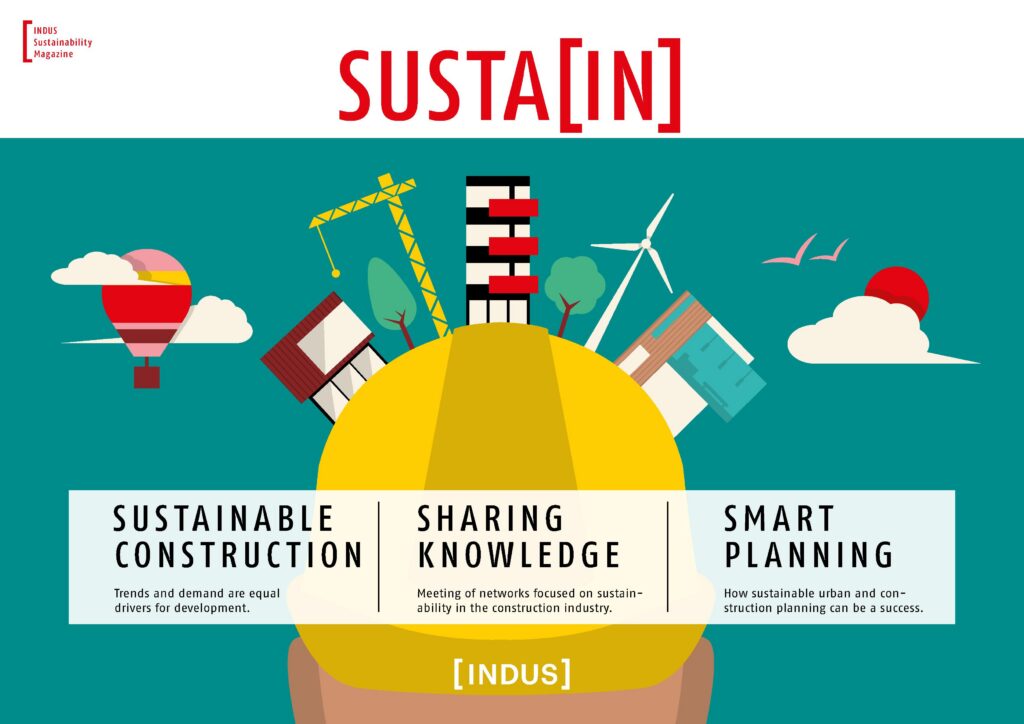
SEIZING OPPORTUNITIES – SUSTAINABLY
EditorialWe will exceed the Paris Agreement’s 1.5-degree target before 2030. The plan is to limit global warming to this level over the long term. Greenhouse gas emissions in Germany rose by 4.5% in 2021 according to German Environment Agency figures. This was after we had been doing well in 2020 with an 8.7% reduction. Germany wants to tackle housing demand in its cities by building 400,000 new apartments every year. In 2021, the total was barely 293,000 new apartments, once again significantly fewer than needed.
Is that bad? It depends on how we react. Setbacks drive us to make corrections. They motivate us. We need both – urgently. Last fall, shortly before the latest climate conference in Glasgow, the UN published an alarming report on the current climate policy of the global community. According to the report, countries need to expand their efforts seven-fold if they truly want to meet the 1.5-degree target.
Seven-fold? That might seem impossible – were it not for human ingenuity and the experience that urgency always seems to be necessary to inspire great change. This last point is abundantly clear – not many people would dispute it these days.
The carbon footprint needs to come down as fast and as much as possible – including, and in particular, in the areas where we live and work. With Construction/ Infrastructure, we have a segment in our Group that is focused on exactly this field. The construction industry is not just an important economic driver, but it is also a future field with a great deal of innova - tion. Sustainable materials, circular building material processes, the intelligent connection of electricity, heat and mobility: Brand new value chains are springing up in the construction sector, and the INDUS companies are involved in shaping them.
What exactly does that mean? You can find out more here, in our second sustainability magazine. Our Group is also very actively working towards creating a sustainable balance between the interests of nature, people and the economy.